Henrik Magnusson
Bygging-Uddemann undeniably has a remarkable history. With over 80 years in a relatively high-risk industry, it is primarily our long experience of carrying out projects in all parts of the world that makes it difficult for new competitors to establish themselves. References from previous successful projects are often absolutely decisive.
The key to our position is a fearless attitude toward international expansion. By entering multiple markets early on, we have been able to shift focus when a single market has slowed down. Swedish industry has always been bold in going beyond its borders, and our corporate culture is built on that same courage.
We have also been good at finding niches where we become crucial to our customers’ success. Our contribution often represents a small part of the total construction cost, but with our long experience and expertise, we become a decisive factor for the final result. For many international construction companies, we serve as a guarantee – especially when they take on new types of projects or establish themselves in a new market.
Of course, our strong position is also based on quality and skilled engineers, which has enabled us to continuously develop new solutions and applications in line with the needs of the construction industry.
It is above all our technical progress that has made our customers more efficient and profitable. Our entire business concept is based on developing methods – primarily slipform solutions and related products – that save both time and money in the construction process, while offering a safer method than our competitors.
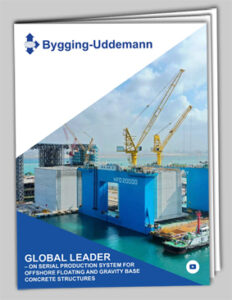
A good example is our complete system for serial production of gigantic concrete structures (caissons), which are used in the construction of harbors, breakwaters, and foundations in the range of 10–20,000 tons. Here, we have succeeded in reducing construction time by as much as 85%.
The technology has been developed entirely in-house, and today we are the only company in the world able to offer it. So far, we have produced more than 4,000 caissons with this system – from Asia and the Middle East to Europe and North Africa.
Over the past six years, we have invested heavily in R&D within floating wind power, with the goal of enabling serial production of large concrete foundations. French company BW-Ideol, a pioneer in floating wind, was a natural partner for our first venture.
Today, we collaborate with several companies in countries such as Japan, the USA, and Spain to adapt the technology to their specific concepts. Our ambition is to become just as relevant and successful in floating wind power as we are in harbor construction globally – and to offer a safe, cost-effective, and industrially proven method.
Being able to contribute our technology to a solution for renewable electricity generation means a lot – both for our brand and for our employees. At the same time, it feels especially meaningful that we are contributing to a sustainable electricity infrastructure for the future.
In Sweden, we look forward with great interest to the development of what will probably be the country’s first project in floating wind – “Poseidon,” where we hope to contribute with our technology.
Success is often built on a chain of events. For us, the journey began in the late 1990s when, together with Hyundai Engineering & Construction (HDEC), we had the opportunity to deliver a slipform solution for a large harbor project in Singapore. There, an early version of our new serial production technology for concrete structures was introduced – and the result was a success.
That such a large company as HDEC dared to invest in technology from a small Swedish company was absolutely decisive. Success breeds success, and together with HDEC, our construction technology was also introduced on the South Korean domestic market. After that, more companies such as Samsung, Daewoo, and DL E&C took notice of us, and through these Korean construction companies our technology spread further to projects in Vietnam, Algeria, and Qatar.
South Korea is a demanding market where you must deliver in order to succeed. But an important factor in our success was that we early on found a very competent local agent – without whom we would not have developed in the same way. After 25 years of traveling back and forth to this fantastic country, South Korea feels almost like my second home – a feeling I share with many colleagues.
We want to be an employer that is both relevant and attractive, and that stands for values in tune with the times. Here, the global goals within Agenda 2030 have been a good guide for what we can contribute to – both as a company and as an employer.
Early on, we invested in our own solar energy, which today covers 60–70% of our energy needs. We have also built up a large stock of construction equipment in South Korea – that is, close to our largest market – to reduce transportation and thus our climate footprint. It is also an economically sustainable solution in times of increased shipping costs and longer transport times.
As mentioned earlier, our investment in floating wind aligns fully with the global goals, where we want to contribute to the development of renewable energy. We were also early in environmental certification (ISO 14001) and, since a year ago, are also certified in occupational health and safety (ISO 45001).
The future looks bright, especially within offshore – both in terms of floating wind power and harbor expansion. Climate change leads to higher and more frequent extreme waves, which creates an increased need for breakwaters built with caissons. Protecting existing harbors is a market we strongly believe in.
The next step for us is to broaden our offering and deliver a more complete package of services and products. This will require more collaborations and new recruitments in certain areas of expertise, but it also means that we can continue to grow – both in Europe and in Asia.

Henrik Magnusson, CEO